
English| EUR
Suggested for you
More currencies
Choose a language
A bottle bought from a caviste and opened on the quais de Seine is an old Parisian habit, not a blanket right. This guide sets out where public consumption is tolerated, where local bans apply, and how the city's cellars, breweries and surviving vineyards fit into the same evening.
Quick answer
Yes, in most cases. Drinking wine in public spaces throughout Paris is generally tolerated but legally restricted, and access to those spaces costs 0 EUR. Squares, quays and parks stay open around the clock at 00:00–23:59, though individual arrondissements post seasonal bans. Verify current arrêtés on paris.fr before uncorking anything.
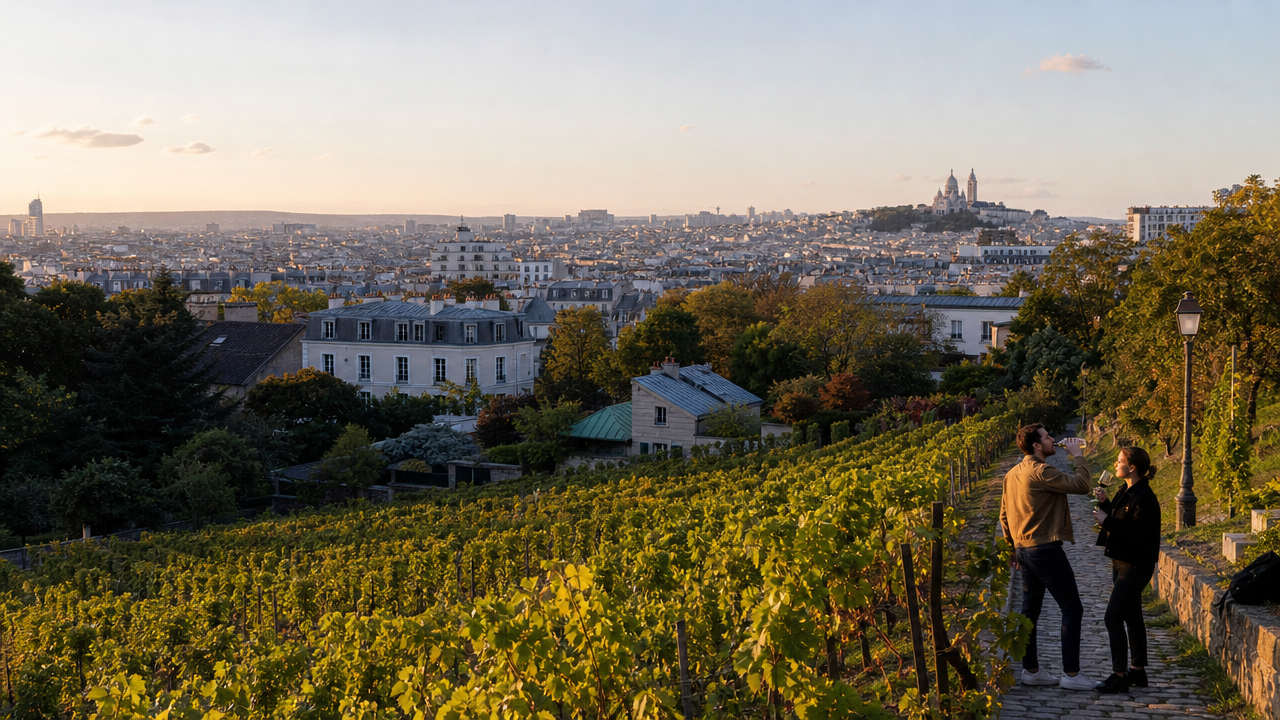
Paris still harvests its own wine. On the north slope of Montmartre, the Clos Montmartre yields roughly 1,000 half-bottles a year, auctioned each October for neighbourhood charities. Smaller plots survive in Belleville and behind the Parc de Bercy. That agricultural thread runs beneath a modern question: can you drink wine in public in Paris without attracting trouble? The answer sits between custom and code, and it shifts by street, by season, and by the mood of the arrondissement. The habit is older than the rules that govern it. Parisians treat the apéro as a public act: a bottle from the caviste, plastic tumblers, a spot on the quais de Seine or the stone edge of the Canal Saint-Martin. Summer evenings fill the Square du Vert-Galant and the terraced lawns of the Parc des Buttes-Chaumont. Nothing about that scene is unusual. What complicates the picture is that France leaves alcohol regulation largely to municipalities, so a Paris public drinking rule is rarely national. The préfecture and individual mairies issue arrêtés that cover named streets, squares and hours, often for a fixed number of months. Signage exists, but it is small, blue and easy to miss. Season matters more than most visitors expect. In August the city empties of residents and fills with travellers, and enforcement around the Bassin de la Villette, the Champ de Mars and the Trocadéro gardens tightens accordingly, largely because of glass rather than alcohol. Breakage on public steps is the recurring complaint, which is why cans, screw caps and small formats have quietly become the local habit. The same summer months put the city's producers on display. Independent microbreweries cluster along the canal in the 18th and 19th, small-batch distilleries have appeared in the eastern arrondissements, and the surviving vineyards open their gates for the September harvest. Anyone researching boire du vin dans la rue à Paris will find that the more interesting answer is not where a bottle may be opened, but where it can be understood. Practical planning follows from that. Travellers who arrive with a bottle and no plan tend to spend the evening scanning for signage; travellers who book a seated tasting spend it learning why a Loire Chenin behaves differently at fourteen degrees than at eighteen. A Paris wine tasting class runs indoors, under a licence, with a sommelier who can explain appellation boundaries, cellar technique and the difference between a négociant and a domaine. Cellar visits in the Marais, brewery tours near the Canal de l'Ourcq and distillery sessions in Belleville work the same way. None of it replaces an evening on the quays. It simply gives the evening a frame. The sensible itinerary uses both: a structured tasting in the afternoon, a bottle and a view afterwards, with the day's arrêtés checked on paris.fr in between. Read that way, can you drink wine in public in Paris stops being a yes-or-no question and becomes a matter of timing, format and district. The vineyards on Montmartre remain the clearest proof that wine here was never only an import.
“The more interesting answer is not where a bottle may be opened, but where it can be understood.”
Drinking wine outdoors is woven into Parisian life, but it sits within a patchwork of municipal rules rather than a blanket right. Certain streets, parks and riverbanks carry police-issued bans, and the difference between tolerated and fined often comes down to where you are standing.
Public spaces in Paris are accessible throughout the day and night. These areas operate on a continuous schedule to accommodate residents and visitors.
Access to public spaces in Paris does not require an entrance fee or specific permits for general pedestrian use. There are no admission costs associated with visiting public parks, squares, or streets.
Verdict: A typical adult pays 0 EUR to access public spaces, as there are no entrance fees or tickets required for general entry.
Navigating the social landscape of enjoying wine in Parisian public spaces requires awareness of local customs and environmental etiquette.
Avoid bringing glass bottles to high-traffic areas like the Seine banks to prevent breakage and injury; opt for lightweight, reusable containers instead.
Carry a small bag for your trash and recycling; local bins often overflow, so taking your refuse with you is expected behavior.
Select seating away from residential windows and narrow pedestrian paths to minimize noise disturbances for locals living nearby.
If you do not have a corkscrew, purchase wine with a screw cap or ask a nearby shopkeeper to open it for you before leaving their premises.
Keep your gathering small and discreet to ensure you do not attract negative attention from municipal authorities who may enforce noise or public order regulations.
Check if nearby parks have specific signs prohibiting alcohol consumption during certain evening hours, as regulations can change based on local municipal decrees.
Everything you need to know about can you drink wine in public in paris
Public consumption of alcohol is generally tolerated in many outdoor spaces, but it is not explicitly permitted and can be restricted by local police. You should always remain mindful of your surroundings and ensure your behavior does not disrupt others when you wonder can you drink wine in public in paris.
While not strictly illegal everywhere, police have the authority to prohibit alcohol consumption in certain areas or during specific times to maintain public order. Being caught in a restricted zone may result in a request to dispose of your drink rather than an immediate fine.
Yes, certain areas such as near schools, hospitals, or specific public squares may have localized bans on alcohol consumption. It is essential to check for posted signage or local police updates if you want to know can you drink wine in public in paris at a particular site.
Enjoying a glass of wine with a meal in a park is a common sight, but it remains a legal gray area that depends on local municipal decrees. Many visitors choose to enjoy a guided tasting experience instead to avoid the uncertainty of local regulations when asking can you drink wine in public in paris.
French law allows for the consumption of alcohol, but public intoxication or creating a disturbance is strictly penalized by law enforcement. Respecting the local environment and the rights of other citizens is the most important rule for those considering this activity.
Visiting a local vineyard or participating in a professional tasting offers a structured and educational environment for wine lovers. These venues provide an authentic experience where you do not need to worry about public consumption rules while enjoying high-quality viticulture.
Best Wine Tasting Classes in Paris
Read more Tickets & toursWine Tasting Workshops
Read more Tickets & toursProfessional Wine Tasting Courses
Read more Tickets & toursCheese and Wine Tasting Classes
Read more Tickets & toursWine Tastings with a Sommelier
Read more Tickets & toursWine & Champagne Tastings
Read more